Stock Market Record Low Yield Poses Significant Challenge
Dividend investing allows investors to focus on fundamentals rather than becoming distracted by the stock market’s constantly changing mood. This premise has been repeated decade after decade by some of the greatest market scholars who ever lived.
This perspective lies at the heart of what we do at Washington Crossing Advisors (WCA). The WCA Rising Dividend portfolio strategy centers on dividend increases from solid, high-quality companies at reasonable prices. Consistent dividend payments from fundamentally strong companies (low debt, profitable assets, consistent business) allow us to look through short-term market noise and stay focused on the long-term prospects of a business.
Compared with growth investing, which seeks capital appreciation from rapidly expanding businesses, dividend investing emphasizes stability and tangible income that can cushion investors during market downturns. Even though total returns are about more than just dividends, investors with a long-term income focus should continue to seek “quality and income at reasonable prices.” Quality dividend stocks have been largely overlooked in the recent market runup, while the chase for AI-led growth has driven the S&P 500 dividend yield to its lowest level since the late 1990s.
Creating Value is Not Just About Dividends
It’s true that returns come from more than just dividends. If we understand dividends as “payment to the owner,” this makes perfect sense.
Imagine that we owned a pizza shop. To grow the shop’s value, we might try to enhance the menu, improve delivery, renovate, or advertise. Early on, we’d probably reinvest back into the business instead of paying ourselves a big dividend. Over time, those investments would (hopefully) increase profits and make our business worth more. In this way, value is created by investing in the business, not by taking money out of it.
Dividends, therefore, don’t create value by themselves. They matter because they signal strength. Mature companies with reliable cash flows can afford to share profits with shareholders, while younger firms often need to reinvest every dollar. Dividend growers tend to be mature, financially stable companies with consistent cash flow and lower volatility. For investors seeking steady income and growth, these are the companies that belong at the top of the list — those that combine tangible cash income with disciplined, long-term growth1 .
Quality at Reasonable Prices
Even though returns are not just about dividends, “quality and income at reasonable prices” helps us focus on what ultimately matters most in the long run.
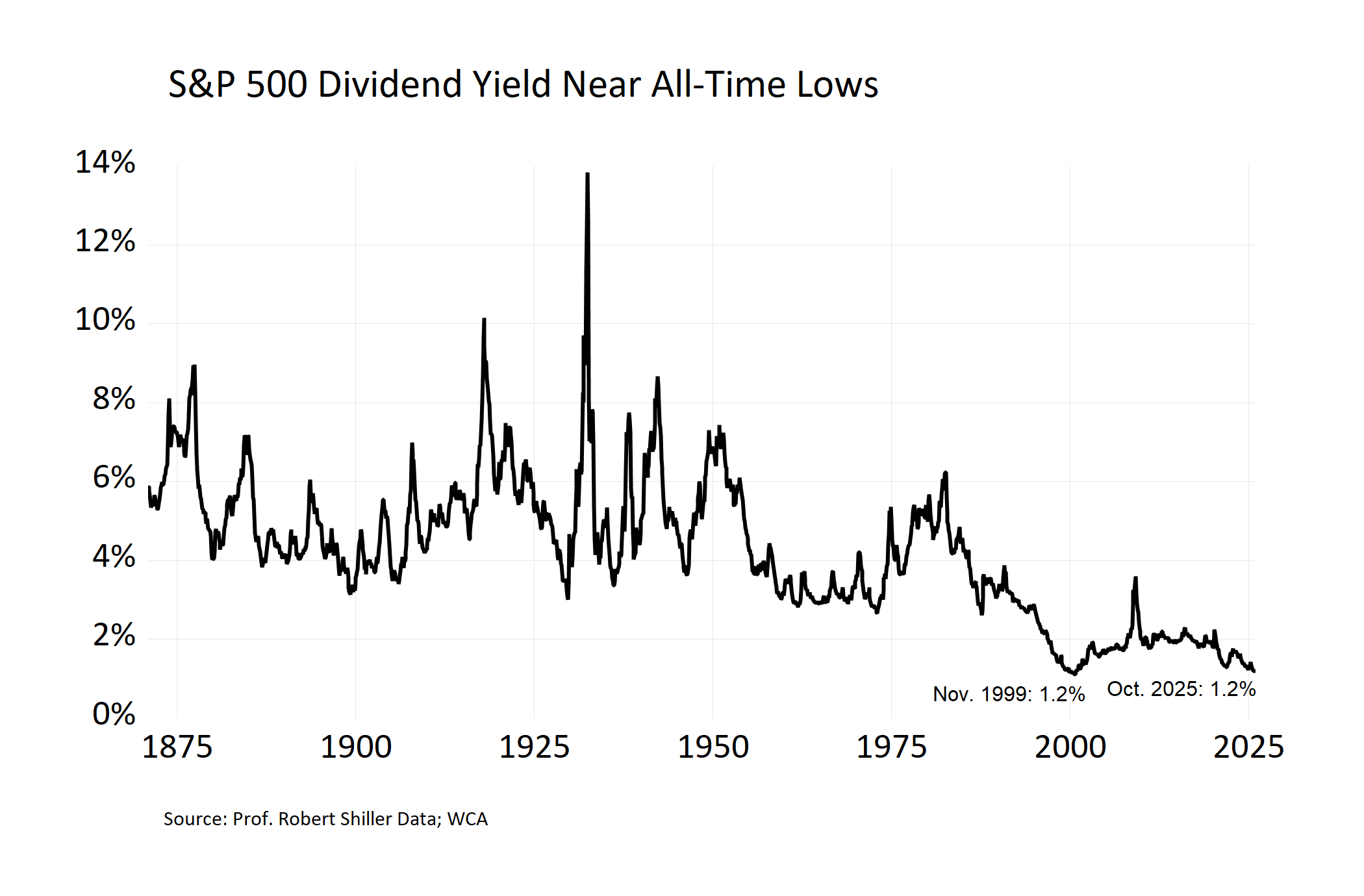
Consider the chart below. The S&P 500 dividend yield has now fallen to levels last seen in the late 1990s and is at the lowest level seen in over a century (Chart A). The decline in yield mirrors a surge in valuations for the largest U.S. stocks. In recent months, growth expectations have soared while risk premiums have collapsed. With the total value of public equities exceeding $70 trillion — up more than $30 trillion since early 2023 — the S&P 500’s yield has fallen to 1.2% from 1.8%. And while a secular trend of declining yields has not meant the stock market could not advance, today’s S&P 500 concentration and valuation extremes make today’s setup less forgiving should the economy slow or risk appetite ebb. This combination of high valuations and compressed yields suggest that markets have already priced in much of the optimism surrounding future growth and may not be receiving adequate compensation for risk.
More simply, the decline in yield means a $100,000 investment now only generates $1,200 in annual cash income, down by a third from $1,800 that the same investment would have generated just two years ago. If we are looking for income from an equity portfolio, today’s market yield is not an attractive proposition in nominal terms and even worse after inflation.
Chart A
Where to Find Quality and Yield
The good news is that opportunities for “quality and income at reasonable prices” still exist — if you’re willing to look.
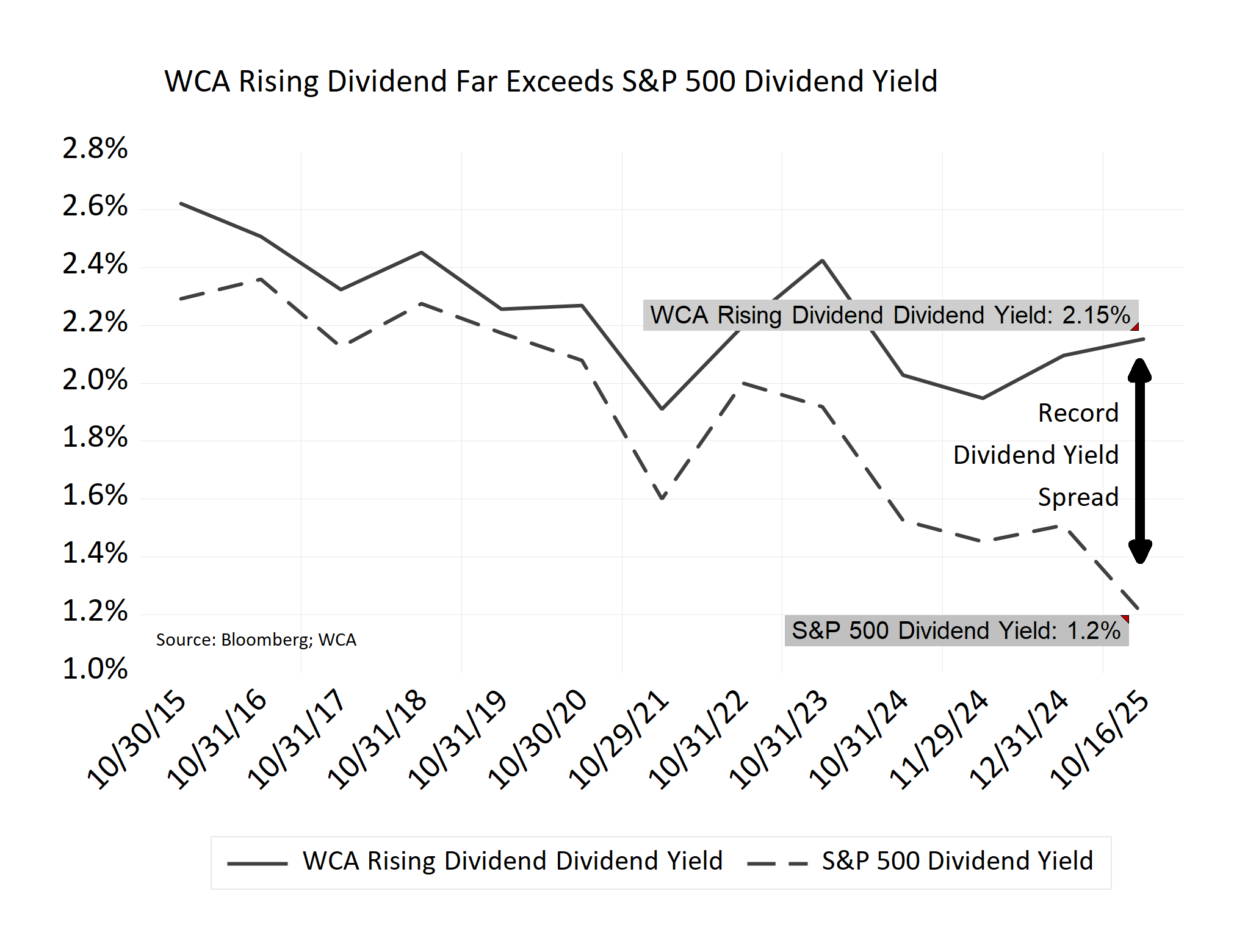
Such stocks tend to offer moderate yields and steady dividend growth rather than high, unsustainable payouts. Today, many of these quality companies provide far better starting yields than the S&P 500. For example, the difference in dividend yield spread between the WCA Rising Dividend portfolio and that of the S&P 500 is now the widest on record (Chart B). The portfolio focuses on dividend growers with low debt, profitable assets, and consistent business models. These companies may not be flashy, but they offer far better value than the S&P 500 or highest-growth names now dominating headlines.
Chart B
Last week, we noted that lower-quality companies — those with more debt, weaker profitability, and inconsistent results — have outperformed higher-quality firms since early 2023 (See “Quality Under Pressure, Patience Required”). This “low-quality cycle” has lasted longer than normal and, in our view, appears set to reverse in the months ahead. Meanwhile, five mega-cap and AI-themed companies now dominate the market narrative, each priced with embedded growth expectations exceeding 10% in perpetuity. While these companies are indeed highly profitable and innovative, their current valuations imply near-permanent dominance with growth that forever exceeds the potential growth rate of the economy — assumptions that are not likely to be validated over the long-run. And should these expectations adjust to a more likely reality, volatility for these stocks — and for the market as a whole — could rise sharply. In that environment, the defensive characteristics of high-quality dividend growers may offer a welcome pocket of calm.
As history has shown through multiple market cycles, it’s often the companies that endure stress well that separate long-term success from failure. (See our recent commentary titled “Why Market Stress Favors Quality: The Macroeconomic Case for Quality Investing” for more on defensive characteristics).
Conclusion
Dividend growth investing combines the benefits of tangible income with consistent, compounding growth from dependable companies, making it an effective counterweight to speculative concentration. The objective is to build a rising stream of income from high-quality businesses purchased at reasonable prices — not chasing yield from financially weak firms or paying excessive prices for growth or the next big story.
Although total returns are not solely about dividends, investors should continue to seek quality and income at reasonable prices for two key reasons:
- High-quality dividend stocks have been overlooked, creating an attractive entry point.
- The pursuit of hyper-growth has driven the S&P 500’s dividend yield to record lows, setting the stage for heightened market risk.
In other words, while markets may celebrate the exciting and the new, enduring wealth is most often built through patience, discipline, and a steady flow of dividends from quality companies. When sentiment eventually shifts — as history suggests it inevitably will — those quality fundamentals will matter most.
———————————
Footnote:
1 We do not include share buybacks in this analysis, but others might include buybacks as a component of total return or shareholder yield. Buybacks are not appropriate in this context for two main reasons. First, they do not represent an actual cash payment to an owner, nor do they represent investment for growth back into the business. Second, buybacks provide less of a signal of financial health because they are exercised on a discretionary basis. Buybacks are not declared in the same way that dividends are and are often increased, foregone, or eliminated with little fanfare or notice. We have not found buybacks to be as consequential as regular dividends from the perspective of identifying quality fundamentals. In recent years, buybacks have been substantial with quarterly buybacks for S&P 500 companies ranging from about $200-250 billion according to research by Yardeni & Associates.
Kevin R. Caron, CFA
Senior Portfolio Manager
973-549-4051
Chad Morganlander
Senior Portfolio Manager
973-549-4052
Steve Lerit, CFA
Head of Portfolio Risk
973-549-4028
Eric Needham
External Sales and Marketing
312-771-6010
Matthew Battipaglia
Portfolio Manager
973-549-4047
Jeffrey Battipaglia
Client Portfolio Manager
973-549-4031
Suzanne Ashley
Internal Relationship Manager
973-549-4168
S&P 500 — The Standard & Poor’s 500 Index is a capitalization-weighted index that is generally considered representative of the U.S. large capitalization market.
Indices are unmanaged, and it is not possible to invest directly in an index. All benchmark returns presented are provided to represent the investment environment existing during the time periods shown. Actual investment performance will vary due to fees and expenses. For comparison purposes, the benchmarks include the reinvestment of income. The benchmarks are unmanaged and unavailable for direct investment.
The S&P 500 High Beta Index measures the performance of 100 constituents in the S&P 500 that are most sensitive to changes in the market. Constituents are weighted relative to their level of market sensitivity, with each stock assigned a weight proportional to its beta.
The S&P 500 Low Volatility Index measures performance of the 100 least volatile stocks in the S&P 500. The index benchmarks low volatility or low variance strategies for the U.S. stock market. Constituents are weighted relative to the inverse of their corresponding volatility, with the least volatile stocks receiving the highest weights.
Disclosures:
WCA Barometer – We regularly assess changes in fundamental conditions to help guide near-term asset allocation decisions. Analysis incorporates approximately 30 forward-looking indicators in categories ranging from Credit and Capital Markets to U.S. Economic Conditions and Foreign Conditions. From each category of data, we create three diffusion-style sub-indices that measure the trends in the underlying data. Sustained improvement that is spread across a wide variety of observations will produce index readings above 50 (potentially favoring stocks), while readings below 50 would indicate potential deterioration (potentially favoring bonds). The WCA Fundamental Conditions Index combines the three underlying categories into a single summary measure. This measure can be thought of as a “barometer” for changes in fundamental conditions.
Standard & Poor’s 500 Index (S&P 500) is a capitalization-weighted index that is generally considered representative of the U.S. large capitalization market.
The S&P 500® Information Technology comprises those companies included in the S&P 500 that are classified as members of the GICS® information technology sector.
S&P Global (SPGI) is a leading American provider of financial information, analytics, and credit ratings, headquartered in New York, NY. It operates major divisions including S&P Global Ratings, S&P Global Market Intelligence, S&P Global Commodity Insights, S&P Global Mobility, and S&P Dow Jones Indices.
The ICE BofA U.S. High Yield Index is an unmanaged index that tracks the performance of U.S. dollar denominated, below investment-grade rated corporate debt publicly issued in the U.S. domestic market.
The S&P 500 Growth measures constituents from the S&P 500 that are classified as growth stocks based on three factors: sales growth, the ratio of earnings change to price, and momentum.
The S&P 500 Value Index measures constituents from the S&P 500 that are classified as value stocks based on three factors: the ratios of book value, earnings and sales to price.
The S&P 500 Equal Weight Index is the equal-weight version of the widely regarded Standard & Poor’s 500 Index, which is generally considered representative of the U.S. large capitalization market. The index has the same constituents as the capitalization-weighted S&P 500, but each company in the index is allocated a fixed weight of 0.20% at each quarterly rebalancing.
The WCA Rising Dividend Custom Benchmark is a rules-based benchmark constructed by Washington Crossing Advisors to represent a universe of large capitalization U.S. companies that meet certain quality and dividend growth criteria, including proprietary screens for profitability, earnings consistency, and balance sheet strength, along with minimum market capitalization and dividend growth requirements. The benchmark is reconstituted and rebalanced quarterly and is intended to serve as a style-appropriate benchmark for the WCA Rising Dividend strategy.
The Washington Crossing Advisors’ High Quality Index and Low Quality Index are objective, quantitative measures designed to identify quality in the top 1,000 U.S. companies. Ranked by fundamental factors, WCA grades companies from “A” (top quintile) to “F” (bottom quintile). Factors include debt relative to equity, asset profitability, and consistency in performance. Companies with lower debt, higher profitability, and greater consistency earn higher grades. These indices are reconstituted annually and rebalanced daily. For informational purposes only, and WCA Quality Grade indices do not reflect the performance of any WCA investment strategy.
The risk of loss in trading commodities and futures can be substantial. You should therefore carefully consider whether such trading is suitable for you in light of your financial condition. The high degree of leverage that is often obtainable in commodity trading can work against you as well as for you. The use of leverage can lead to large losses as well as gains.
The information contained herein has been prepared from sources believed to be reliable but is not guaranteed by us and is not a complete summary or statement of all available data, nor is it considered an offer to buy or sell any securities referred to herein. Opinions expressed are subject to change without notice and do not take into account the particular investment objectives, financial situation, or needs of individual investors. There is no guarantee that the figures or opinions forecast in this report will be realized or achieved. Employees of Stifel, Nicolaus & Company, Incorporated or its affiliates may, at times, release written or oral commentary, technical analysis, or trading strategies that differ from the opinions expressed within. Past performance is no guarantee of future results. Indices are unmanaged, and you cannot invest directly in an index.
Asset allocation and diversification do not ensure a profit and may not protect against loss. There are special considerations associated with international investing, including the risk of currency fluctuations and political and economic events. Changes in market conditions or a company’s financial condition may impact a company’s ability to continue to pay dividends, and companies may also choose to discontinue dividend payments. Investing in emerging markets may involve greater risk and volatility than investing in more developed countries. Due to their narrow focus, sector-based investments typically exhibit greater volatility. Small-company stocks are typically more volatile and carry additional risks since smaller companies generally are not as well established as larger companies. Property values can fall due to environmental, economic, or other reasons, and changes in interest rates can negatively impact the performance of real estate companies. When investing in bonds, it is important to note that as interest rates rise, bond prices will fall. High-yield bonds have greater credit risk than higher-quality bonds. Bond laddering does not assure a profit or protect against loss in a declining market. The risk of loss in trading commodities and futures can be substantial. You should therefore carefully consider whether such trading is suitable for you in light of your financial condition. The high degree of leverage that is often obtainable in commodity trading can work against you as well as for you. The use of leverage can lead to large losses as well as gains. Changes in market conditions or a company’s financial condition may impact a company’s ability to continue to pay dividends, and companies may also choose to discontinue dividend payments.
All investments involve risk, including loss of principal, and there is no guarantee that investment objectives will be met. It is important to review your investment objectives, risk tolerance, and liquidity needs before choosing an investment style or manager. Equity investments are subject generally to market, market sector, market liquidity, issuer, and investment style risks, among other factors to varying degrees. Fixed Income investments are subject to market, market liquidity, issuer, investment style, interest rate, credit quality, and call risks, among other factors to varying degrees.
Beta is a measure of the volatility, or systematic risk, of a security or a portfolio relative to the market as a whole. A beta of one is considered as risky as the benchmark and is therefore likely to provide expected returns approximate to those of the benchmark during both up and down periods. A portfolio with a beta of two would move approximately twice as much as the benchmark.
Standard deviation is a measure of the volatility of a security’s or portfolio’s returns in relation to the mean return. The larger the standard deviation, the greater the volatility of return in relation to the mean return.
Changes in market conditions or a company’s financial condition may impact a company’s ability to continue to pay dividends, and companies may also choose to discontinue dividend payments
This commentary often expresses opinions about the direction of market, investment sector, and other trends. The opinions should not be considered predictions of future results. The information contained in this report is based on sources believed to be reliable, but is not guaranteed and not necessarily complete.
The securities discussed in this material were selected due to recent changes in the strategies. This selection criterion is not based on any measurement of performance of the underlying security.
Washington Crossing Advisors, LLC is a wholly-owned subsidiary and affiliated SEC Registered Investment Adviser of Stifel Financial Corp (NYSE: SF). Registration with the SEC implies no level of sophistication in investment management.