Leverage and Quality
It is essential not to overlook critical assumptions. One of the most basic stock investing beliefs is that firms will continue to exist — firms do not live forever. Beginning as a start-up and ending in decline, firms undergo many changes over their lives. An idea becomes a business that generates growing profits and revenue. As a result of sound investing, the company continues to grow, finds new markets, and fends off competitors. At some point, the demand for the firm’s product or service slows, competition erodes advantages, and the business shrinks. In an age of rapid technological change and business disruption, entire industries can live a decade in an instant. When coupled with heavy debts and leverage, such sudden changes can be a toxic mix for stockholders.
Along the way, businesses fund growth through a variety of sources. Some capital is raised from owners, while other capital is raised from creditors and shows up as debt. So long as the debt goes to profitable investments to drive growth, the debt can be a blessing rather than a curse. But, like a game of musical chairs, if the music stops playing and the value of the firm’s assets starts a process of decline, the chance of default rises. In a default, where debt is not serviced on time, the stock’s value can be completely wiped out. Focusing on companies with low debt and conservative finances can help keep this scenario from playing out in your portfolio.
Low leverage, thus, is an attribute of a “high-quality” company, in our view.
Nature of Failure
The nature of failure risk is peculiar and hard to predict but often arises in recession. Failure risk due to leverage can come on slowly or all at once, and it can happen to well-known and established firms. In every downturn, we hear about such firms that fail to make it to the other side of the economic cycle. One of the most significant risks to a company’s survival is the amount of debt used to finance its assets.
When borrowing drives the accumulation of assets faster than owners’ equity, we can say that leverage has increased. As leverage increases, changes in asset values are amplified down to equity owners, increasing a stock’s volatility and risk. The risk brought about by high leverage can be intensified as the firm transitions in its lifecycle from growth to decline.
History and theory have much to say about how fast the decline and default process can play out. Consider the experience 2007-2009 Global Financial Crisis (GFC), where leverage risks became evident.
GFC Experience
Here is a sampling of high leverage companies that were wiped out, or nearly so, in the Global Financial Crisis of 2007-2009. Note that these firms all have high leverage in common. The ratio of assets to owners’ equity is significant (at or above 10x). Moreover, the leverage was not seen as troublesome to credit rating agencies on the eve of the downturn in late 2006. The credits were all highly rated by Standard & Poor’s rating agency. Yet, once the downturn set in, the losses were far more than what was implied by analysts’ high ratings. The failures were extraordinarily rapid and brought near-total losses for many stock investors.
A Sample of Leveraged Firms
From the Global Financial Crisis
| Firm | 2006 S&P Rating | 2006 Leverage Assets/Equity | 2006 Yr. End Stock Price | 2008 Yr. End Stock Price | Acquirer |
|---|---|---|---|---|---|
| Bear Stearns | A | 29-1 | $160 | $9 | JPM Chase |
| Washington Mutual | A- | 13-1 | $45 | $0 | JPM Chase |
| AIG | AA | 10-1 | $60 | $1 | U.S. Government* |
| Fannie Mae | AAA | 20-1 | $59 | $1 | U.S. Government |
| Countrywide Financial | A | 14-1 | $42 | $4 | Bank of America |
| Merrill Lynch | AA- | 22-1 | $93 | $12 | Bank of America |
| Wachovia | A+ | 13-1 | $57 | $5 | Wells Fargo |
| Lehman | A+ | 13-1 | $78 | $0 | Barclays/Nomura |
| * Majority owner |
Source: Standard & Poor’s; Bloomberg
Financial Theory
Analyzing defaults occupies the realm of credit risk analysis in finance. There are many ways to estimate and think about losses and their potential arising from defaults. None of the models in existence offer a perfect crystal ball. Yet, one model helps provide some intuition when looking to understand risks related to a company’s equity and debt. The model is called a “structural model” and comes from Robert Merton, who won a Nobel prize for his work in finance and economics in 1997. If you want to read his original work, you can find Merton’s paper here and a brief summary is presented in the callout box at the bottom of this commentary.
In essence, the model relies on option pricing models to estimate the likelihood of default and views equity as a call on a firm’s assets. The key point is that the probability of default (horizontal axis) accelerates rapidly with high amounts of debt and leverage (vertical axis). Once the value of assets exceeds five times equity value (5x leverage), theoretical default risk accelerates non-linearly. Note that the companies listed in the GFC table above had leverage factors that placed them on the “elbow” part of the curve or higher.
Applying the Model
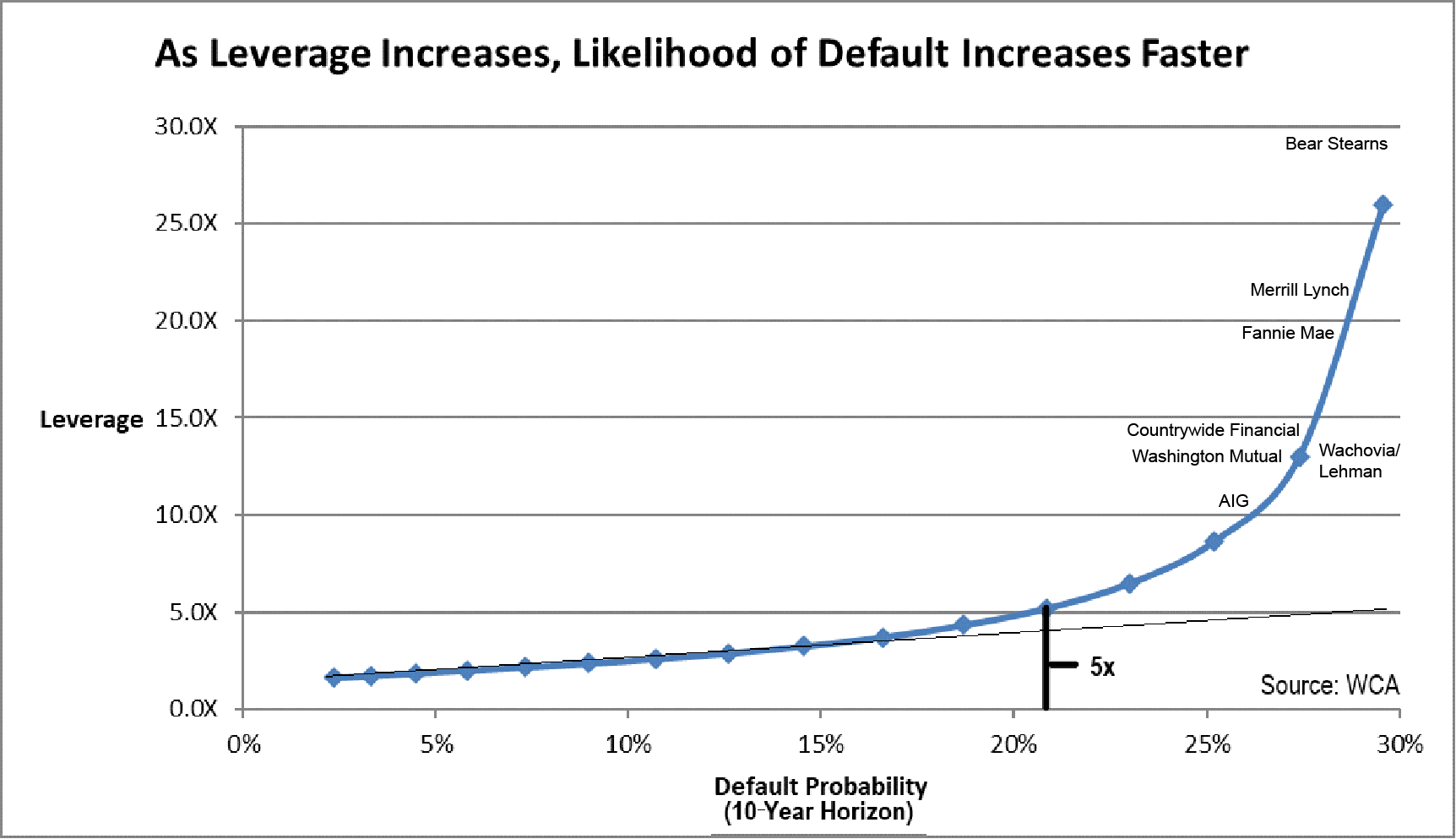
The above model does have its limitations. Balance sheets can be complex, changing interest rates and economic conditions can impact outcomes, and asset values can’t always be known with certainty. Notably, the model also relies on the assumption that asset returns are “normal,” despite considerable evidence to the contrary. In the real world, asset returns have “fat tails.” This means negative surprises (significant losses) happened more than what would be expected. This is a major reason to err on the side of caution when it comes to investing in indebted companies.
Conclusion
Whether considering financial history or theory, we think there is plenty of reason to play it conservatively when it comes to debt. In today’s world, where debt is rising, “zombie companies” are common, and many industries are being disrupted by new technology. It makes sense to look at how leverage might impact your portfolio.
As this recent Bloomberg article points out, markets are rapidly driving up companies’ prices with weak balance sheets. During a more challenging market, we would expect these companies to underperform those of less indebted, higher-quality firms. Building a “quality” portfolio starts with finding quality companies. There is no better place to start than looking at how firms use debt to fund their businesses.
A Merton Model Summary
Disclosures:
WCA Barometer – We regularly assess changes in fundamental conditions to help guide near-term asset allocation decisions. Analysis incorporates approximately 30 forward-looking indicators in categories ranging from Credit and Capital Markets to U.S. Economic Conditions and Foreign Conditions. From each category of data, we create three diffusion-style sub-indices that measure the trends in the underlying data. Sustained improvement that is spread across a wide variety of observations will produce index readings above 50 (potentially favoring stocks), while readings below 50 would indicate potential deterioration (potentially favoring bonds). The WCA Fundamental Conditions Index combines the three underlying categories into a single summary measure. This measure can be thought of as a “barometer” for changes in fundamental conditions.
Standard & Poor’s 500 Index (S&P 500) is a capitalization-weighted index that is generally considered representative of the U.S. large capitalization market.
S&P Global (SPGI) is a leading American provider of financial information, analytics, and credit ratings, headquartered in New York, NY. It operates major divisions including S&P Global Ratings, S&P Global Market Intelligence, S&P Global Commodity Insights, S&P Global Mobility, and S&P Dow Jones Indices.
The ICE BofA U.S. High Yield Index is an unmanaged index that tracks the performance of U.S. dollar denominated, below investment-grade rated corporate debt publicly issued in the U.S. domestic market.
The S&P 500 Growth measures constituents from the S&P 500 that are classified as growth stocks based on three factors: sales growth, the ratio of earnings change to price, and momentum.
The S&P 500 Value Index measures constituents from the S&P 500 that are classified as value stocks based on three factors: the ratios of book value, earnings and sales to price.
The S&P 500 Equal Weight Index is the equal-weight version of the widely regarded Standard & Poor’s 500 Index, which is generally considered representative of the U.S. large capitalization market. The index has the same constituents as the capitalization-weighted S&P 500, but each company in the index is allocated a fixed weight of 0.20% at each quarterly rebalancing.
The WCA Rising Dividend Custom Benchmark is a rules-based benchmark constructed by Washington Crossing Advisors to represent a universe of large capitalization U.S. companies that meet certain quality and dividend growth criteria, including proprietary screens for profitability, earnings consistency, and balance sheet strength, along with minimum market capitalization and dividend growth requirements. The benchmark is reconstituted and rebalanced quarterly and is intended to serve as a style-appropriate benchmark for the WCA Rising Dividend strategy.
The Washington Crossing Advisors’ High Quality Index and Low Quality Index are objective, quantitative measures designed to identify quality in the top 1,000 U.S. companies. Ranked by fundamental factors, WCA grades companies from “A” (top quintile) to “F” (bottom quintile). Factors include debt relative to equity, asset profitability, and consistency in performance. Companies with lower debt, higher profitability, and greater consistency earn higher grades. These indices are reconstituted annually and rebalanced daily. For informational purposes only, and WCA Quality Grade indices do not reflect the performance of any WCA investment strategy.
The risk of loss in trading commodities and futures can be substantial. You should therefore carefully consider whether such trading is suitable for you in light of your financial condition. The high degree of leverage that is often obtainable in commodity trading can work against you as well as for you. The use of leverage can lead to large losses as well as gains.
The information contained herein has been prepared from sources believed to be reliable but is not guaranteed by us and is not a complete summary or statement of all available data, nor is it considered an offer to buy or sell any securities referred to herein. Opinions expressed are subject to change without notice and do not take into account the particular investment objectives, financial situation, or needs of individual investors. There is no guarantee that the figures or opinions forecast in this report will be realized or achieved. Employees of Stifel, Nicolaus & Company, Incorporated or its affiliates may, at times, release written or oral commentary, technical analysis, or trading strategies that differ from the opinions expressed within. Past performance is no guarantee of future results. Indices are unmanaged, and you cannot invest directly in an index.
Asset allocation and diversification do not ensure a profit and may not protect against loss. There are special considerations associated with international investing, including the risk of currency fluctuations and political and economic events. Changes in market conditions or a company’s financial condition may impact a company’s ability to continue to pay dividends, and companies may also choose to discontinue dividend payments. Investing in emerging markets may involve greater risk and volatility than investing in more developed countries. Due to their narrow focus, sector-based investments typically exhibit greater volatility. Small-company stocks are typically more volatile and carry additional risks since smaller companies generally are not as well established as larger companies. Property values can fall due to environmental, economic, or other reasons, and changes in interest rates can negatively impact the performance of real estate companies. When investing in bonds, it is important to note that as interest rates rise, bond prices will fall. High-yield bonds have greater credit risk than higher-quality bonds. Bond laddering does not assure a profit or protect against loss in a declining market. The risk of loss in trading commodities and futures can be substantial. You should therefore carefully consider whether such trading is suitable for you in light of your financial condition. The high degree of leverage that is often obtainable in commodity trading can work against you as well as for you. The use of leverage can lead to large losses as well as gains. Changes in market conditions or a company’s financial condition may impact a company’s ability to continue to pay dividends, and companies may also choose to discontinue dividend payments.
All investments involve risk, including loss of principal, and there is no guarantee that investment objectives will be met. It is important to review your investment objectives, risk tolerance, and liquidity needs before choosing an investment style or manager. Equity investments are subject generally to market, market sector, market liquidity, issuer, and investment style risks, among other factors to varying degrees. Fixed Income investments are subject to market, market liquidity, issuer, investment style, interest rate, credit quality, and call risks, among other factors to varying degrees.
Beta is a measure of the volatility, or systematic risk, of a security or a portfolio relative to the market as a whole. A beta of one is considered as risky as the benchmark and is therefore likely to provide expected returns approximate to those of the benchmark during both up and down periods. A portfolio with a beta of two would move approximately twice as much as the benchmark.
Standard deviation is a measure of the volatility of a security’s or portfolio’s returns in relation to the mean return. The larger the standard deviation, the greater the volatility of return in relation to the mean return.
Changes in market conditions or a company’s financial condition may impact a company’s ability to continue to pay dividends, and companies may also choose to discontinue dividend payments
This commentary often expresses opinions about the direction of market, investment sector, and other trends. The opinions should not be considered predictions of future results. The information contained in this report is based on sources believed to be reliable, but is not guaranteed and not necessarily complete.
The securities discussed in this material were selected due to recent changes in the strategies. This selection criterion is not based on any measurement of performance of the underlying security.
Washington Crossing Advisors, LLC is a wholly-owned subsidiary and affiliated SEC Registered Investment Adviser of Stifel Financial Corp (NYSE: SF). Registration with the SEC implies no level of sophistication in investment management.