A Hit to Q1 Growth
Global business activity is taking an unexpected hit from worries over the coronavirus outbreak, according to recent data from IHS Markit. As the chart below shows, the IHS Markit purchasing managers’ index fell sharply through mid-February with U.S. Services Business Activity Index falling to 49.4 (53.4 in January), a 76-month low. The IHS Manufacturing Survey (below) also fell to 50.8 (51.9 in January), a 6-month low. New orders fell for the first time since data collection began in 2009.
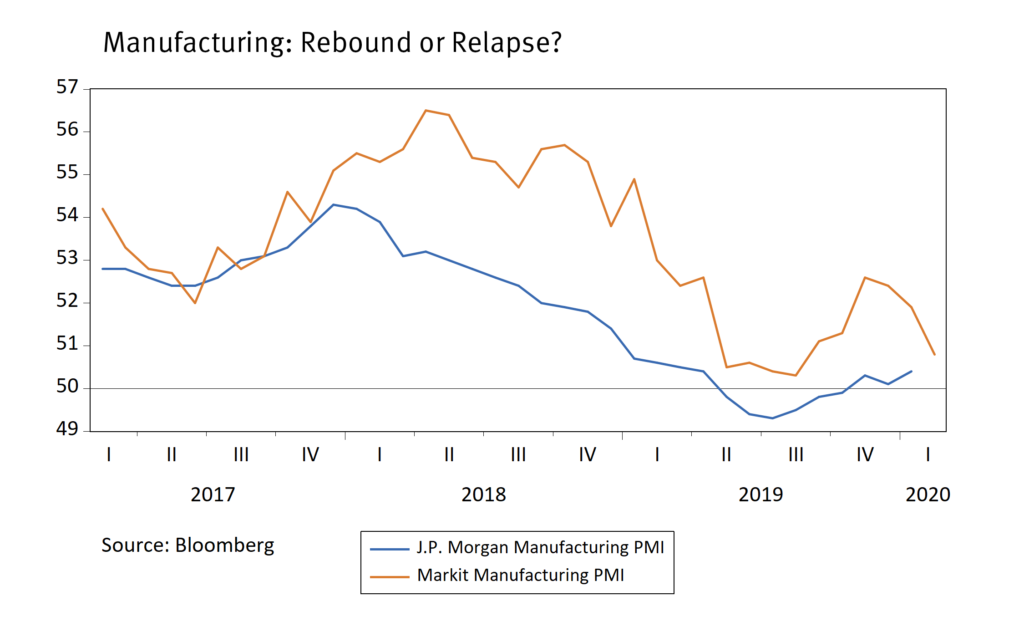
Hesitancy among firms due to coronavirus is causing a decline in business activity in the United States. This is the conclusion reached by IHS Markit’s economist in reaction to the surveys mentioned above. Chris Williamson, Chief Business Economist at IHS Markit, said: “Manufacturing production ground almost to a halt due to a near-stalling of orders.” He went on to say that the survey data was consistent with a 0.6% pace of GDP growth in February, down from 2% in January. Somewhat counterintuitively, he also said that business sentiment about the year ahead saw a notable upturn, reflecting “widespread optimism that the current slowdown will prove short-lived.”
The Test for Bulls
For the bullish case for stocks to stay intact, it is important that business confidence remains firm. To see a pickup in earnings to support higher valuations, businesses confidence and capital spending will need to see a boost. The downtrend in global activity in 2019, exhibited in the chart above, halted in the back half of last year. Monetary easing, a trade truce, and leaner inventories set the stage for a sustained upswing at the start of the year. However, two new wildcards — coronavirus and uncertainty over the U.S. election — pose risks to this outlook. A relapse into contracting business activity or a darkening profit outlook would make the bull case for equities a harder one to advance.
Safe Assets Rally
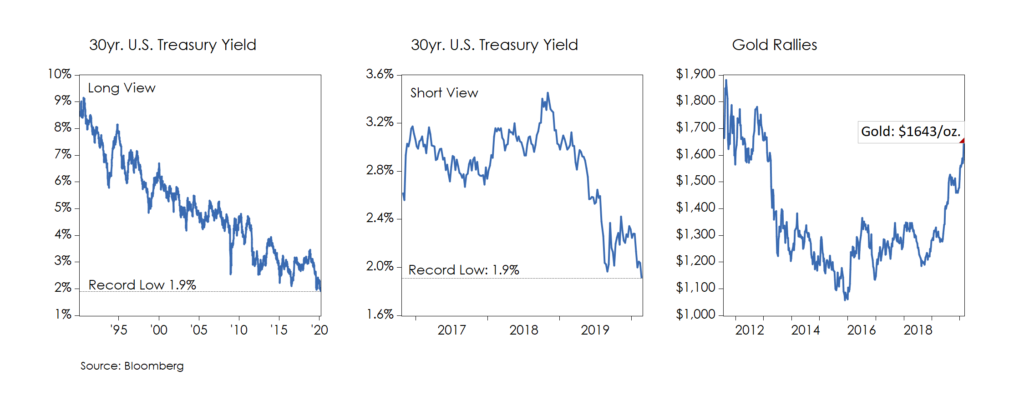
Another record low was set last year for long-term U.S. Treasury bond yields (charts, above left). The 30-year U.S. Treasury bond fell to yield near 1.9% last Friday after two strong days of gains in the bond market. Never before has the long bond carried such a low yield. The 30-year inflation rate priced into inflation-protected Treasury bonds is only 1.7%, implying that the market is priced to realize just a 0.2% real return for holding the most extended end of the Treasury yield curve. Also, the spread between 10-year U.S. Treasury yields and 3-month Treasury bills again turned negative last week and ended the week at -7 basis points (-0.07%). As we discussed last summer, this “inversion” or negative spread is often seen as a harbinger of slowing growth or recession.
As bonds have rallied, so too has gold (chart, above right). Gold is up 26% since last June versus a 22% gain in the S&P 500 (a large-cap U.S. equity market index). The rise in gold and jump in Treasury prices can mean that investors are seeking “insurance” or “safe” assets. Such run-ups are not uncommon during uncertain times but can reverse course violently once the proximate cause of market jitters fade.
Conclusion
The last week’s market action and dataflow did little to advance a bullish case and suggest worries over the coronavirus will likely hurt near-term growth. A bigger question remains: will business confidence continue to hold up despite the coronavirus outbreak and jitters surrounding upcoming U.S. elections. If confidence does hold up, the hit to growth could prove short-lived and be followed by a sharp second-half rebound.
Kevin Caron, CFA, Senior Portfolio Manager
Chad Morganlander, Senior Portfolio Manager
Matthew Battipaglia, Portfolio Manager
Steve Lerit, CFA, Client Portfolio Manager
Suzanne Ashley, Analyst
(973) 549-4168
www.washingtoncrossingadvisors.com
www.stifel.com
Disclosures:
WCA Barometer – We regularly assess changes in fundamental conditions to help guide near-term asset allocation decisions. Analysis incorporates approximately 30 forward-looking indicators in categories ranging from Credit and Capital Markets to U.S. Economic Conditions and Foreign Conditions. From each category of data, we create three diffusion-style sub-indices that measure the trends in the underlying data. Sustained improvement that is spread across a wide variety of observations will produce index readings above 50 (potentially favoring stocks), while readings below 50 would indicate potential deterioration (potentially favoring bonds). The WCA Fundamental Conditions Index combines the three underlying categories into a single summary measure. This measure can be thought of as a “barometer” for changes in fundamental conditions.
Standard & Poor’s 500 Index (S&P 500) is a capitalization-weighted index that is generally considered representative of the U.S. large capitalization market.
S&P Global (SPGI) is a leading American provider of financial information, analytics, and credit ratings, headquartered in New York, NY. It operates major divisions including S&P Global Ratings, S&P Global Market Intelligence, S&P Global Commodity Insights, S&P Global Mobility, and S&P Dow Jones Indices.
The ICE BofA U.S. High Yield Index is an unmanaged index that tracks the performance of U.S. dollar denominated, below investment-grade rated corporate debt publicly issued in the U.S. domestic market.
The S&P 500 Growth measures constituents from the S&P 500 that are classified as growth stocks based on three factors: sales growth, the ratio of earnings change to price, and momentum.
The S&P 500 Value Index measures constituents from the S&P 500 that are classified as value stocks based on three factors: the ratios of book value, earnings and sales to price.
The S&P 500 Equal Weight Index is the equal-weight version of the widely regarded Standard & Poor’s 500 Index, which is generally considered representative of the U.S. large capitalization market. The index has the same constituents as the capitalization-weighted S&P 500, but each company in the index is allocated a fixed weight of 0.20% at each quarterly rebalancing.
The WCA Rising Dividend Custom Benchmark is a rules-based benchmark constructed by Washington Crossing Advisors to represent a universe of large capitalization U.S. companies that meet certain quality and dividend growth criteria, including proprietary screens for profitability, earnings consistency, and balance sheet strength, along with minimum market capitalization and dividend growth requirements. The benchmark is reconstituted and rebalanced quarterly and is intended to serve as a style-appropriate benchmark for the WCA Rising Dividend strategy.
The Washington Crossing Advisors’ High Quality Index and Low Quality Index are objective, quantitative measures designed to identify quality in the top 1,000 U.S. companies. Ranked by fundamental factors, WCA grades companies from “A” (top quintile) to “F” (bottom quintile). Factors include debt relative to equity, asset profitability, and consistency in performance. Companies with lower debt, higher profitability, and greater consistency earn higher grades. These indices are reconstituted annually and rebalanced daily. For informational purposes only, and WCA Quality Grade indices do not reflect the performance of any WCA investment strategy.
The risk of loss in trading commodities and futures can be substantial. You should therefore carefully consider whether such trading is suitable for you in light of your financial condition. The high degree of leverage that is often obtainable in commodity trading can work against you as well as for you. The use of leverage can lead to large losses as well as gains.
The information contained herein has been prepared from sources believed to be reliable but is not guaranteed by us and is not a complete summary or statement of all available data, nor is it considered an offer to buy or sell any securities referred to herein. Opinions expressed are subject to change without notice and do not take into account the particular investment objectives, financial situation, or needs of individual investors. There is no guarantee that the figures or opinions forecast in this report will be realized or achieved. Employees of Stifel, Nicolaus & Company, Incorporated or its affiliates may, at times, release written or oral commentary, technical analysis, or trading strategies that differ from the opinions expressed within. Past performance is no guarantee of future results. Indices are unmanaged, and you cannot invest directly in an index.
Asset allocation and diversification do not ensure a profit and may not protect against loss. There are special considerations associated with international investing, including the risk of currency fluctuations and political and economic events. Changes in market conditions or a company’s financial condition may impact a company’s ability to continue to pay dividends, and companies may also choose to discontinue dividend payments. Investing in emerging markets may involve greater risk and volatility than investing in more developed countries. Due to their narrow focus, sector-based investments typically exhibit greater volatility. Small-company stocks are typically more volatile and carry additional risks since smaller companies generally are not as well established as larger companies. Property values can fall due to environmental, economic, or other reasons, and changes in interest rates can negatively impact the performance of real estate companies. When investing in bonds, it is important to note that as interest rates rise, bond prices will fall. High-yield bonds have greater credit risk than higher-quality bonds. Bond laddering does not assure a profit or protect against loss in a declining market. The risk of loss in trading commodities and futures can be substantial. You should therefore carefully consider whether such trading is suitable for you in light of your financial condition. The high degree of leverage that is often obtainable in commodity trading can work against you as well as for you. The use of leverage can lead to large losses as well as gains. Changes in market conditions or a company’s financial condition may impact a company’s ability to continue to pay dividends, and companies may also choose to discontinue dividend payments.
All investments involve risk, including loss of principal, and there is no guarantee that investment objectives will be met. It is important to review your investment objectives, risk tolerance, and liquidity needs before choosing an investment style or manager. Equity investments are subject generally to market, market sector, market liquidity, issuer, and investment style risks, among other factors to varying degrees. Fixed Income investments are subject to market, market liquidity, issuer, investment style, interest rate, credit quality, and call risks, among other factors to varying degrees.
Beta is a measure of the volatility, or systematic risk, of a security or a portfolio relative to the market as a whole. A beta of one is considered as risky as the benchmark and is therefore likely to provide expected returns approximate to those of the benchmark during both up and down periods. A portfolio with a beta of two would move approximately twice as much as the benchmark.
Standard deviation is a measure of the volatility of a security’s or portfolio’s returns in relation to the mean return. The larger the standard deviation, the greater the volatility of return in relation to the mean return.
Changes in market conditions or a company’s financial condition may impact a company’s ability to continue to pay dividends, and companies may also choose to discontinue dividend payments
This commentary often expresses opinions about the direction of market, investment sector, and other trends. The opinions should not be considered predictions of future results. The information contained in this report is based on sources believed to be reliable, but is not guaranteed and not necessarily complete.
The securities discussed in this material were selected due to recent changes in the strategies. This selection criterion is not based on any measurement of performance of the underlying security.
Washington Crossing Advisors, LLC is a wholly-owned subsidiary and affiliated SEC Registered Investment Adviser of Stifel Financial Corp (NYSE: SF). Registration with the SEC implies no level of sophistication in investment management.