Quality Under Pressure, Patience Required
Our recent lag versus the S&P 500 reflects a market led by lower-quality and extremely highly valued companies. While challenging, this is a well-understood dynamic of quality investing. Low-quality phases can last for a time, but history has shown they were followed by renewed leadership in high quality. The current low-quality phase is already longer than average and may be nearing exhaustion. Credit and valuation signals now suggest downside risks are rising even as the economy continues to expand.
Where We Are Now
This has been a speculative stretch: lower rate hopes, and pro-growth policy expectations have pulled the leadership toward weaker balance sheets and more volatile earnings. In such periods, low quality has typically outperformed high quality — and our discipline can trail. Over the past year, our high-quality, “A”-Grade index rose just 2.2% versus a 31% gain for lower quality, “F”-Grade companies. This is not an aberration, but a familiar dynamic of quality investing.
As we remind prospective clients in every WCA Rising Dividend fact sheet:
“High quality styles tend to perform better in flat to down markets, but lag in strong bull markets. Because the strategy avoids high debt and volatile earnings, performance can differ substantially from traditional value strategies.”
The current environment has rewarded return-seeking with little regard for risk. However, when risk inevitably reasserts, investors have historically turned back to the durability, flexibility, and predictability of high quality. We have seen this time and time again in the past.
What Are Quality Cycles?
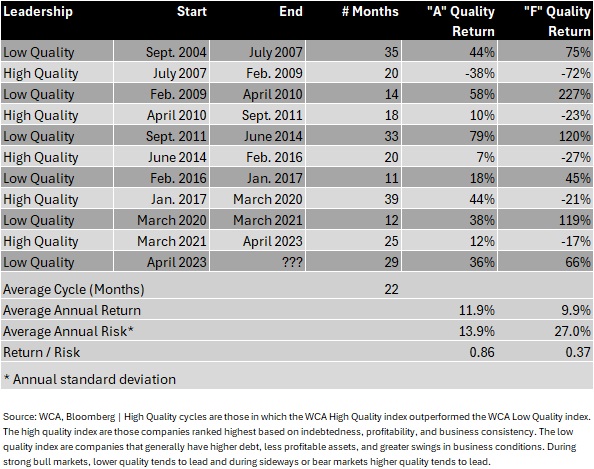
Our research has shown leadership rotates in multi-quarter waves that average about 22 months. We are now roughly 30 months into the current low-quality run — already longer than average (Chart A – WCA Quality Cycles).
According to our research:
• Low-quality phases can deliver strong “junk rallies” (e.g., 2009–10: Low-Quality +227% vs. High-Quality +58%; 2020–21: Low-Quality +119% vs. High-Quality +38%).
• Low quality carries enormous volatility, exciting on the way up but brutal on the way down.
• High quality provides steadier compounding and far better downside protection (e.g., 2007–09: High-Quality −38% vs. −72% for low quality; 2014–16: High-Quality +7% vs. −27% for Low-Quality).
Today’s low-quality rally has exceeded historical averages in both duration (29 vs. 22 months) and magnitude (Low-Quality is up 66% vs. 42% average Low-Quality cycle return). Patience may again be rewarded as the cycle matures. Over the past 20 years, the WCA “A”-Quality index returned 11.9% annually versus 9.1% for “F”-Quality, with far less volatility, according to Bloomberg data. One of the keys is to remain invested in high quality through a complete market cycle.
Chart A – WCA Quality Index Cycles
Credit As a Cycle Tell
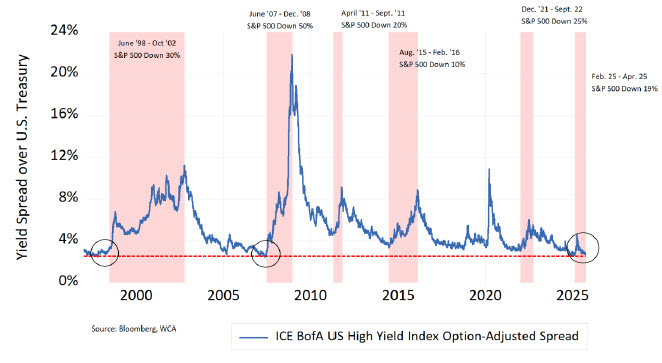
Credit markets often provide an early signal for cycle changes. Low-quality leadership typically coincides with tightening high-yield spreads, while high quality holds up better when spreads widen. Today, spreads sit near multi-decade lows at ~2.7% — about two standard deviations below the long-run average of 5.25%. Past episodes at similar levels (late-1990s, mid-2007) were followed by violent repricing (Chart B – High Yield Corporate Bond Spread Over Treasuries). Tight spreads rarely leave much margin of safety and can signal tipping points long before any singular “event” becomes apparent.
Chart B – High Yield Corporate Bond Spread Over Treasuries
Valuations Pricing In Rapid Growth
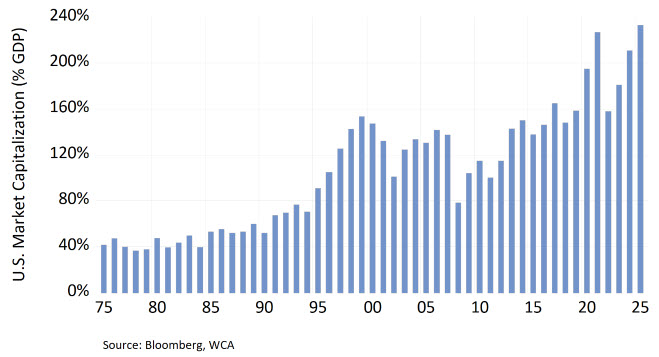
In addition to low-quality leadership, we also see momentum feeding unreasonable growth expectations and stretched valuations in some areas. Consider that U.S. public equities now are worth about $70 trillion versus a $30 trillion economy* (private equity would only add to the $70 trillion figure). This large multiple, even without factoring in private equity, reflects optimism but also leaves little compensation for risk (Chart C – Highly Valued Stock Market). As we noted in “The Illusion of Perpetual Growth“, more than half of the S&P 500’s market capitalization is priced with implied growth above 5% — faster than the 5% nominal growth rate the economy has delivered over the past decade. Among these, the average expected growth rate is about 7.5% and can reach 16% for the most “expectation rich” growth equities*. Rising expectations and momentum have pushed valuations to levels extremely difficult to reconcile with fundamentals.
Chart C – Highly Valued Stock Market: U.S. Market Capitalization Relative to GDP Rises to Record
Focus on Fundamentals
Ultimately, fundamentals act as a grounding force for stock prices. Despite lagging benchmarks, our Rising Dividend portfolio has continued to deliver strong fundamental and operating results:
• EPS growth near 10.7% annualized this year through August
• No dividend cuts and ongoing dividend increases
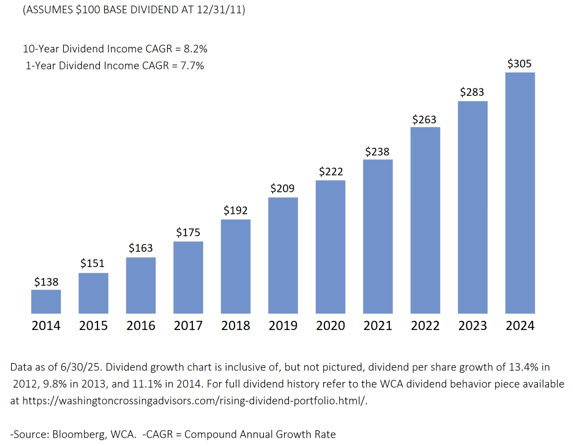
• Average dividend growth of ~9% with payout ratios near 50% (Chart D – WCA Rising Dividend 10-Year Dividend Growth)
This consistency reflects the defensive and compounding characteristics we seek from a group of high-quality companies.
Chart D – WCA Rising Dividend 10-Year Dividend Growth
Why “Quality at a Reasonable Price” Still Makes Sense
We continue to believe that high quality endures, even if it does not lead in every period. Our approach — buying high-quality companies with rising dividends at reasonable prices — has delivered durable, risk-adjusted returns through many cycles. With the current low-quality run extended, credit spreads very tight, and valuations stretched, the odds favor a return to the durability, flexibility, and predictability of quality companies with rising dividends. Staying disciplined, even in the face of short-term lag, has historically rewarded patient investors.
Recent market leadership has also been concentrated in a narrow set of companies with very high valuations and growth expectations. These ‘expectation-rich’ stocks have powered popular benchmarks higher, while more reasonably valued, high-quality businesses have lagged.
Because our Rising Dividend strategy emphasizes quality at a reasonable price, we expect to trail when markets are driven by low quality and speculation. In fact, if we were outperforming in this type of environment, it would be a red flag that we had strayed from our core discipline. Our role is not to chase fads, but to remain consistent in focusing on companies with strong balance sheets, steady earnings, and rising dividends.
History has shown that while no strategy leads in every market, high-quality styles tend to fare better in flat or down environments when fundamentals reassert themselves. By staying disciplined today, we aim to compound wealth more reliably over time.
* Source: Bloomberg, WCA
Contacts:
Kevin Caron, CFA, Senior Portfolio Manager
Chad Morganlander, Senior Portfolio Manager
Matthew Battipaglia, Portfolio Manager
Steve Lerit, CFA, Head of Portfolio Risk
Suzanne Ashley, Relationship Manager
Eric Needham, Sales Director
Jeff Battipaglia, Sales and Marketing
(973) 549-4168
www.washingtoncrossingadvisors.com
Disclosures:
WCA Barometer – We regularly assess changes in fundamental conditions to help guide near-term asset allocation decisions. Analysis incorporates approximately 30 forward-looking indicators in categories ranging from Credit and Capital Markets to U.S. Economic Conditions and Foreign Conditions. From each category of data, we create three diffusion-style sub-indices that measure the trends in the underlying data. Sustained improvement that is spread across a wide variety of observations will produce index readings above 50 (potentially favoring stocks), while readings below 50 would indicate potential deterioration (potentially favoring bonds). The WCA Fundamental Conditions Index combines the three underlying categories into a single summary measure. This measure can be thought of as a “barometer” for changes in fundamental conditions.
Standard & Poor’s 500 Index (S&P 500) is a capitalization-weighted index that is generally considered representative of the U.S. large capitalization market.
The S&P 500® Information Technology comprises those companies included in the S&P 500 that are classified as members of the GICS® information technology sector.
S&P Global (SPGI) is a leading American provider of financial information, analytics, and credit ratings, headquartered in New York, NY. It operates major divisions including S&P Global Ratings, S&P Global Market Intelligence, S&P Global Commodity Insights, S&P Global Mobility, and S&P Dow Jones Indices.
The ICE BofA U.S. High Yield Index is an unmanaged index that tracks the performance of U.S. dollar denominated, below investment-grade rated corporate debt publicly issued in the U.S. domestic market.
The S&P 500 Growth measures constituents from the S&P 500 that are classified as growth stocks based on three factors: sales growth, the ratio of earnings change to price, and momentum.
The S&P 500 Value Index measures constituents from the S&P 500 that are classified as value stocks based on three factors: the ratios of book value, earnings and sales to price.
The S&P 500 Equal Weight Index is the equal-weight version of the widely regarded Standard & Poor’s 500 Index, which is generally considered representative of the U.S. large capitalization market. The index has the same constituents as the capitalization-weighted S&P 500, but each company in the index is allocated a fixed weight of 0.20% at each quarterly rebalancing.
The WCA Rising Dividend Custom Benchmark is a rules-based benchmark constructed by Washington Crossing Advisors to represent a universe of large capitalization U.S. companies that meet certain quality and dividend growth criteria, including proprietary screens for profitability, earnings consistency, and balance sheet strength, along with minimum market capitalization and dividend growth requirements. The benchmark is reconstituted and rebalanced quarterly and is intended to serve as a style-appropriate benchmark for the WCA Rising Dividend strategy.
The Washington Crossing Advisors’ High Quality Index and Low Quality Index are objective, quantitative measures designed to identify quality in the top 1,000 U.S. companies. Ranked by fundamental factors, WCA grades companies from “A” (top quintile) to “F” (bottom quintile). Factors include debt relative to equity, asset profitability, and consistency in performance. Companies with lower debt, higher profitability, and greater consistency earn higher grades. These indices are reconstituted annually and rebalanced daily. For informational purposes only, and WCA Quality Grade indices do not reflect the performance of any WCA investment strategy.
The risk of loss in trading commodities and futures can be substantial. You should therefore carefully consider whether such trading is suitable for you in light of your financial condition. The high degree of leverage that is often obtainable in commodity trading can work against you as well as for you. The use of leverage can lead to large losses as well as gains.
The information contained herein has been prepared from sources believed to be reliable but is not guaranteed by us and is not a complete summary or statement of all available data, nor is it considered an offer to buy or sell any securities referred to herein. Opinions expressed are subject to change without notice and do not take into account the particular investment objectives, financial situation, or needs of individual investors. There is no guarantee that the figures or opinions forecast in this report will be realized or achieved. Employees of Stifel, Nicolaus & Company, Incorporated or its affiliates may, at times, release written or oral commentary, technical analysis, or trading strategies that differ from the opinions expressed within. Past performance is no guarantee of future results. Indices are unmanaged, and you cannot invest directly in an index.
Asset allocation and diversification do not ensure a profit and may not protect against loss. There are special considerations associated with international investing, including the risk of currency fluctuations and political and economic events. Changes in market conditions or a company’s financial condition may impact a company’s ability to continue to pay dividends, and companies may also choose to discontinue dividend payments. Investing in emerging markets may involve greater risk and volatility than investing in more developed countries. Due to their narrow focus, sector-based investments typically exhibit greater volatility. Small-company stocks are typically more volatile and carry additional risks since smaller companies generally are not as well established as larger companies. Property values can fall due to environmental, economic, or other reasons, and changes in interest rates can negatively impact the performance of real estate companies. When investing in bonds, it is important to note that as interest rates rise, bond prices will fall. High-yield bonds have greater credit risk than higher-quality bonds. Bond laddering does not assure a profit or protect against loss in a declining market. The risk of loss in trading commodities and futures can be substantial. You should therefore carefully consider whether such trading is suitable for you in light of your financial condition. The high degree of leverage that is often obtainable in commodity trading can work against you as well as for you. The use of leverage can lead to large losses as well as gains. Changes in market conditions or a company’s financial condition may impact a company’s ability to continue to pay dividends, and companies may also choose to discontinue dividend payments.
All investments involve risk, including loss of principal, and there is no guarantee that investment objectives will be met. It is important to review your investment objectives, risk tolerance, and liquidity needs before choosing an investment style or manager. Equity investments are subject generally to market, market sector, market liquidity, issuer, and investment style risks, among other factors to varying degrees. Fixed Income investments are subject to market, market liquidity, issuer, investment style, interest rate, credit quality, and call risks, among other factors to varying degrees.
Beta is a measure of the volatility, or systematic risk, of a security or a portfolio relative to the market as a whole. A beta of one is considered as risky as the benchmark and is therefore likely to provide expected returns approximate to those of the benchmark during both up and down periods. A portfolio with a beta of two would move approximately twice as much as the benchmark.
Standard deviation is a measure of the volatility of a security’s or portfolio’s returns in relation to the mean return. The larger the standard deviation, the greater the volatility of return in relation to the mean return.
Changes in market conditions or a company’s financial condition may impact a company’s ability to continue to pay dividends, and companies may also choose to discontinue dividend payments
This commentary often expresses opinions about the direction of market, investment sector, and other trends. The opinions should not be considered predictions of future results. The information contained in this report is based on sources believed to be reliable, but is not guaranteed and not necessarily complete.
The securities discussed in this material were selected due to recent changes in the strategies. This selection criterion is not based on any measurement of performance of the underlying security.
Washington Crossing Advisors, LLC is a wholly-owned subsidiary and affiliated SEC Registered Investment Adviser of Stifel Financial Corp (NYSE: SF). Registration with the SEC implies no level of sophistication in investment management.