Dividends Are Front Page News
Today, The Wall Street Journal ran a front-page, above-the-fold article titled “Dividend Darlings Trail Stock Market Despite Pumped-Up Yields.” The authors point to underperformance by dividend payers within the S&P 500 Dividend Aristocrats index, an equally weighted index consisting of all S&P 500 companies that have increased dividends every year for the past 25 consecutive years. The article highlights some iconic dividend payers with large yields suffering large share price drops this year. So says The Wall Street Journal: “Exxon Mobil Corp., whose dividend yield is sitting at a near-record of more than 10%, has declined 51% in 2020… AT&T Inc., with a dividend yield of more than 7%, has fallen 29%… And Walgreens Boots Alliance Inc., offering a nearly 5% dividend yield, has plummeted 35%…”
The article goes on to say that $40 billion has been pulled from global dividend-focused mutual and exchange-traded funds in 2020, according to data from EPFR. Oil price swings, COVID-19 impacts, and worries over potentially large loan losses at banks all contributed to dividend stock troubles.
Not Surprising
Dividend troubles amid high yielding stocks are not surprising to us, as we look at value and dividend investing differently than traditional value managers. Unlike conventional value managers, who tend to focus on multiples of earnings or book value, along with dividend yield, we focus on a growing intrinsic value. Intrinsic value is rooted in cash flow, risk, profitability, and managerial investment decisions. Multiples of book value, for example, have little, if any, bearing on wealth creation. Our interest in dividend growth only matters as such growth provides something of a signal that a company’s management expects growth to persist into the future, but, in our view, dividends are never a reason for buying a stock, per se.
Paying a certain dividend out of uncertain earnings can’t make earnings any less risky. And, if dividends are paid when they shouldn’t be, then penalties arise. By paying dividends, a company has less money available to fund growth. If debt or equity is raised to replace the dividend, then shareholders are diluted as new claims on future cash flow are also created. To the extent that firms engage in aggressive debt issuance to finance dividends, rising leverage can also increase future default probability — never a good outcome for stock investors.
Bird In Hand
Sometimes dividends are described as a “bird in hand.” This theory says that investors should value a dollar of dividends today higher than uncertain capital gains in the future. But does a dividend make a stock less risky to own? Isn’t a bird in the hand (a dividend) worth two in the bush (a capital gain)? Hardly! Dividends paid are capital gains lost for sure because a firm’s value immediately declines by the amount of the dividend. That cash is gone from the books of the firm forever, thereby reducing value and potential capital gains. Again, the mere act of paying a certain dividend can never make a company’s business or earnings any more certain, and as already discussed, it can even lead to greater risk and uncertainty.
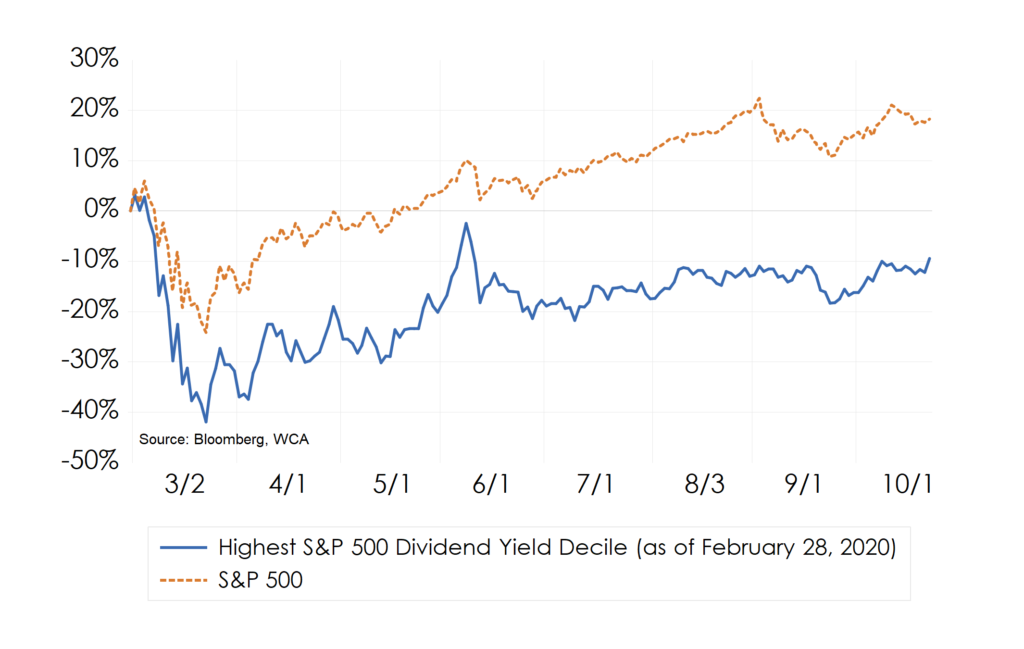
If you bought the highest yielding 10% of the Standard & Poor’s 500 index at the end of February, just before COVID-19 hit the United States hard, you would now own a portfolio down -10%, including dividend payments. A simple investment in the Standard & Poor’s 500 index would be up 18%. The resulting 28% underperformance shows how a “high yield” does not always mean the same thing as a “high return” and can very quickly turn into “high risk.”
Chart A
Growth Trends Converge
Conclusion
Today’s cover story in The Wall Street Journal is yet another reminder of why a company’s profitability, quality, and flexibility matter most. A price multiple and a dividend yield are silent on all of these most important factors, and investors seeking safety should exercise caution when searching for yield.
Disclosures:
WCA Barometer – We regularly assess changes in fundamental conditions to help guide near-term asset allocation decisions. Analysis incorporates approximately 30 forward-looking indicators in categories ranging from Credit and Capital Markets to U.S. Economic Conditions and Foreign Conditions. From each category of data, we create three diffusion-style sub-indices that measure the trends in the underlying data. Sustained improvement that is spread across a wide variety of observations will produce index readings above 50 (potentially favoring stocks), while readings below 50 would indicate potential deterioration (potentially favoring bonds). The WCA Fundamental Conditions Index combines the three underlying categories into a single summary measure. This measure can be thought of as a “barometer” for changes in fundamental conditions.
Standard & Poor’s 500 Index (S&P 500) is a capitalization-weighted index that is generally considered representative of the U.S. large capitalization market.
The S&P 500® Information Technology comprises those companies included in the S&P 500 that are classified as members of the GICS® information technology sector.
S&P Global (SPGI) is a leading American provider of financial information, analytics, and credit ratings, headquartered in New York, NY. It operates major divisions including S&P Global Ratings, S&P Global Market Intelligence, S&P Global Commodity Insights, S&P Global Mobility, and S&P Dow Jones Indices.
The ICE BofA U.S. High Yield Index is an unmanaged index that tracks the performance of U.S. dollar denominated, below investment-grade rated corporate debt publicly issued in the U.S. domestic market.
The S&P 500 Growth measures constituents from the S&P 500 that are classified as growth stocks based on three factors: sales growth, the ratio of earnings change to price, and momentum.
The S&P 500 Value Index measures constituents from the S&P 500 that are classified as value stocks based on three factors: the ratios of book value, earnings and sales to price.
The S&P 500 Equal Weight Index is the equal-weight version of the widely regarded Standard & Poor’s 500 Index, which is generally considered representative of the U.S. large capitalization market. The index has the same constituents as the capitalization-weighted S&P 500, but each company in the index is allocated a fixed weight of 0.20% at each quarterly rebalancing.
The WCA Rising Dividend Custom Benchmark is a rules-based benchmark constructed by Washington Crossing Advisors to represent a universe of large capitalization U.S. companies that meet certain quality and dividend growth criteria, including proprietary screens for profitability, earnings consistency, and balance sheet strength, along with minimum market capitalization and dividend growth requirements. The benchmark is reconstituted and rebalanced quarterly and is intended to serve as a style-appropriate benchmark for the WCA Rising Dividend strategy.
The Washington Crossing Advisors’ High Quality Index and Low Quality Index are objective, quantitative measures designed to identify quality in the top 1,000 U.S. companies. Ranked by fundamental factors, WCA grades companies from “A” (top quintile) to “F” (bottom quintile). Factors include debt relative to equity, asset profitability, and consistency in performance. Companies with lower debt, higher profitability, and greater consistency earn higher grades. These indices are reconstituted annually and rebalanced daily. For informational purposes only, and WCA Quality Grade indices do not reflect the performance of any WCA investment strategy.
The risk of loss in trading commodities and futures can be substantial. You should therefore carefully consider whether such trading is suitable for you in light of your financial condition. The high degree of leverage that is often obtainable in commodity trading can work against you as well as for you. The use of leverage can lead to large losses as well as gains.
The information contained herein has been prepared from sources believed to be reliable but is not guaranteed by us and is not a complete summary or statement of all available data, nor is it considered an offer to buy or sell any securities referred to herein. Opinions expressed are subject to change without notice and do not take into account the particular investment objectives, financial situation, or needs of individual investors. There is no guarantee that the figures or opinions forecast in this report will be realized or achieved. Employees of Stifel, Nicolaus & Company, Incorporated or its affiliates may, at times, release written or oral commentary, technical analysis, or trading strategies that differ from the opinions expressed within. Past performance is no guarantee of future results. Indices are unmanaged, and you cannot invest directly in an index.
Asset allocation and diversification do not ensure a profit and may not protect against loss. There are special considerations associated with international investing, including the risk of currency fluctuations and political and economic events. Changes in market conditions or a company’s financial condition may impact a company’s ability to continue to pay dividends, and companies may also choose to discontinue dividend payments. Investing in emerging markets may involve greater risk and volatility than investing in more developed countries. Due to their narrow focus, sector-based investments typically exhibit greater volatility. Small-company stocks are typically more volatile and carry additional risks since smaller companies generally are not as well established as larger companies. Property values can fall due to environmental, economic, or other reasons, and changes in interest rates can negatively impact the performance of real estate companies. When investing in bonds, it is important to note that as interest rates rise, bond prices will fall. High-yield bonds have greater credit risk than higher-quality bonds. Bond laddering does not assure a profit or protect against loss in a declining market. The risk of loss in trading commodities and futures can be substantial. You should therefore carefully consider whether such trading is suitable for you in light of your financial condition. The high degree of leverage that is often obtainable in commodity trading can work against you as well as for you. The use of leverage can lead to large losses as well as gains. Changes in market conditions or a company’s financial condition may impact a company’s ability to continue to pay dividends, and companies may also choose to discontinue dividend payments.
All investments involve risk, including loss of principal, and there is no guarantee that investment objectives will be met. It is important to review your investment objectives, risk tolerance, and liquidity needs before choosing an investment style or manager. Equity investments are subject generally to market, market sector, market liquidity, issuer, and investment style risks, among other factors to varying degrees. Fixed Income investments are subject to market, market liquidity, issuer, investment style, interest rate, credit quality, and call risks, among other factors to varying degrees.
Beta is a measure of the volatility, or systematic risk, of a security or a portfolio relative to the market as a whole. A beta of one is considered as risky as the benchmark and is therefore likely to provide expected returns approximate to those of the benchmark during both up and down periods. A portfolio with a beta of two would move approximately twice as much as the benchmark.
Standard deviation is a measure of the volatility of a security’s or portfolio’s returns in relation to the mean return. The larger the standard deviation, the greater the volatility of return in relation to the mean return.
Changes in market conditions or a company’s financial condition may impact a company’s ability to continue to pay dividends, and companies may also choose to discontinue dividend payments
This commentary often expresses opinions about the direction of market, investment sector, and other trends. The opinions should not be considered predictions of future results. The information contained in this report is based on sources believed to be reliable, but is not guaranteed and not necessarily complete.
The securities discussed in this material were selected due to recent changes in the strategies. This selection criterion is not based on any measurement of performance of the underlying security.
Washington Crossing Advisors, LLC is a wholly-owned subsidiary and affiliated SEC Registered Investment Adviser of Stifel Financial Corp (NYSE: SF). Registration with the SEC implies no level of sophistication in investment management.