|

|
An Adobe Acrobat version of this document can be found
here
|
|
|
December 14, 2009 |
| |
Bernanke’s Prayer
During the 1970s, former Federal Reserve
Chairman Paul Volker reviled inflation and prayed for an end
to rapidly rising prices. Today’s Chairman, Ben Bernanke, is
cursed with a world of falling prices which is hurting the
economy and adding to unemployment and foreclosures. In a
monetary sense, he knows that inflation may be the only
thing left that he can influence that has any chance of
stemming the tide of destabilizing asset write-downs,
defaults, and foreclosures. So in the fall of 2008, the Fed
and Treasury, along with a host of other central bankers and
governments, went “all in” to try to stem the liquidation of
debt and assets that began with the sub-prime mortgage
market in 2007. In some sense, this appears to have worked,
albeit at a very high price.
In the United States alone, over $10 trillion
of loans, investments, and taxpayer-financed guarantees were
put in place just to convince lenders that borrowers will
pay – even if the investments went bad. This backstopping of
private obligations took the form of government guarantees
of private loans, which is to say that the taxpayer was
forced to cosign obligations of private companies regardless
of price or rate of return. Whatever the ethical
implications of such a thing might be, policymakers were in
crisis mode and felt that it was the only possible
alternative to achieve the immediate goal of averting
meltdown. So far, it appears like that objective has been
achieved. Over the past six months, confidence in financial
markets seems to have improved, financial capital has begun
to flow, and asset prices have shown some initial signs of
stabilization. At the same time, inflation expectations have
begun to rise, as seen in a steepened yield curve, higher
commodity prices, and a higher inflation rate priced into
inflation-protected Treasury bonds. Thus, it seems as if
Bernanke’s prayer has been answered.
Our own quantitative assessment of the
economy shows that such backstopping has been effective in
turning around markets and various economic indicators. Our
diffusion index, which measures changes in thirty different
indicators of health in the U.S. and foreign economies,
bottomed last winter and now shows that most measures are in
the process of turning for the better. We see that banks are
lending to one another again at reasonable rates; we see
that larger companies can get access to short-term financing
at economically attractive rates; there are some signs of
slowing in the rate of job losses; inventory levels are
improved relative to sales; and so forth. All of this is
positive news and a welcome development.
The improvement is also seen in new data compiled by the
Federal Reserve. That data shows the value of household real
estate rising right alongside the value of equity markets
since the spring. As a result, household net worth has
increased from $48 to $53 trillion in six months. All of
this is positive and has created some sense of optimism that
the economy may be coming back from the recession and has
already begun an economic recovery. We hear nightly about
“V”-shaped growth and “green shoots.”
Yet, for many, there remain some unsettling aspects about
the current situation. We know this because the savings
rate has risen to 4% from below 1% in April 2005. This
increase in savings is certainly not about capturing a high
rate of interest offered by banks, since those rates are
near 0%. Nor is it about consumers having lots of cash
burning a hole in their pocket. The increase relates to
uncertainty about the future. Based on Federal Reserve
data, the average person now holds 36 weeks of income in the
form of deposits versus 34 weeks a couple of years ago. It
is common now for retirement and other savings plans to be
under-funded – in part because of ten years of an
underperforming stock market but also due to changes in
assumptions about assets such as real estate. Similar
shortfalls are being recognized by national government,
state and local governments, large and small businesses, and
charitable organizations. Individuals are aware of these
imbalances, and the threat of higher tax burdens adds to
already tight personal finances.
Since individuals and businesses are not yet convinced that
a turn is at hand, the drive to savings is also accompanied
by a desire to avoid and reduce debt. As for debt reduction,
it can be achieved through pay-down or default and, in the
case of another government intervention, forgiveness. The
Mortgage Bankers Association now reports a foreclosure rate
of 4.5% on all loans compared with a 1% rate, which has been
the more typical experience over the past couple of decades.
Ironically, just as savers are piling into savings at very
low rates, there is scant evidence to suggest that record
low mortgage rates are encouraging a massive new round of
borrowing.
[Click chart to enlarge]
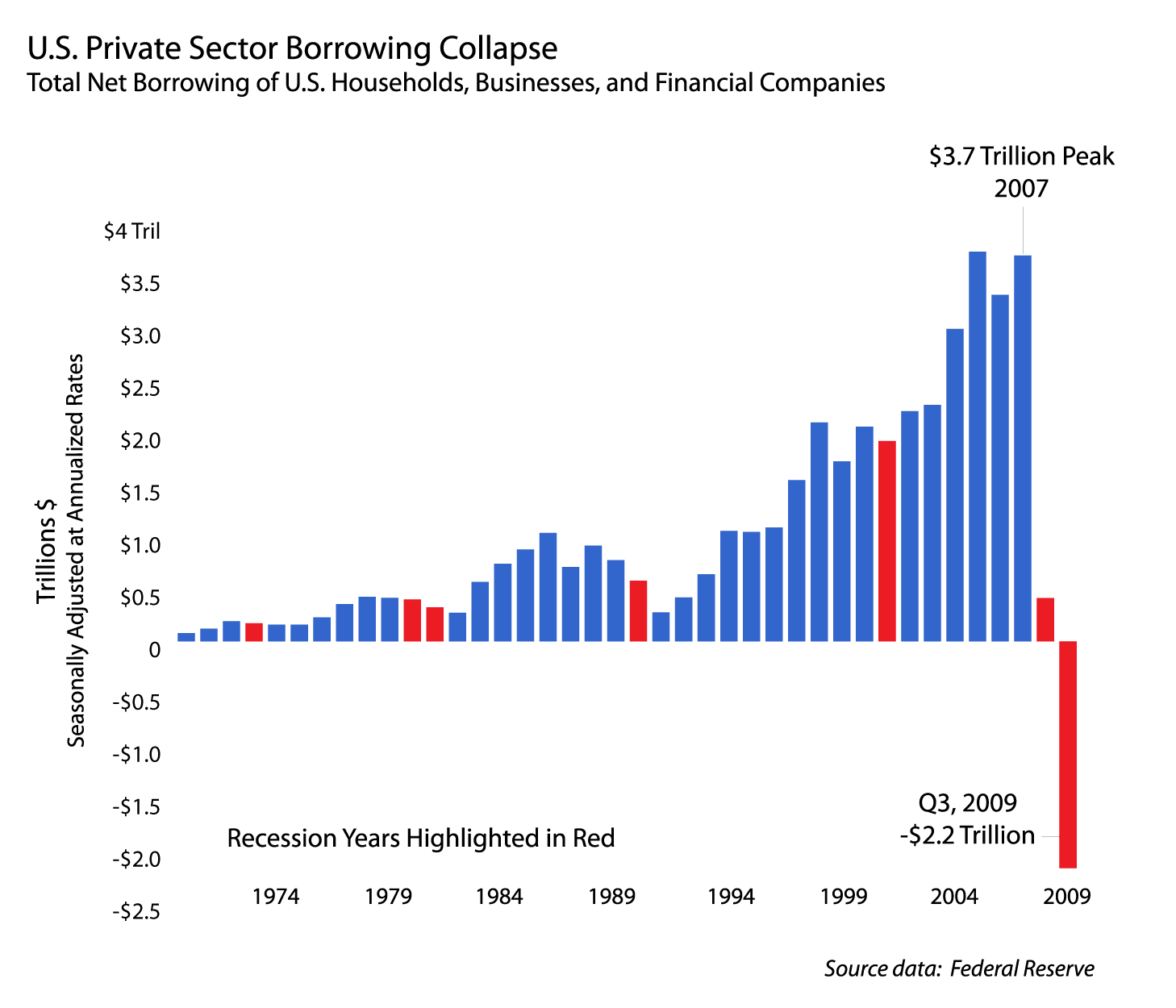
The Federal Reserve’s data shows that total borrowing coming
from the private sector (households, businesses, and
financial companies) is not only lower, but sharply
contracting at a -$2.2 trillion annualized rate as seen in
the above chart. There are three things I want to bring to
your attention about this -$2.2 trillion number. First, the
-$2.2 trillion is a “net” number. In other words, there is
some amount of new borrowing that is occurring, but the
amount of borrowing that is being paid off or written off is
greater than the amount being incurred by -$2.2 trillion. So
the amount of debt extinguishment is actually much higher
than the -$2.2 trillion net number. Second, the -$2.2
trillion number is the only negative number on record with
the Federal Reserve’s data series dating all the way back to
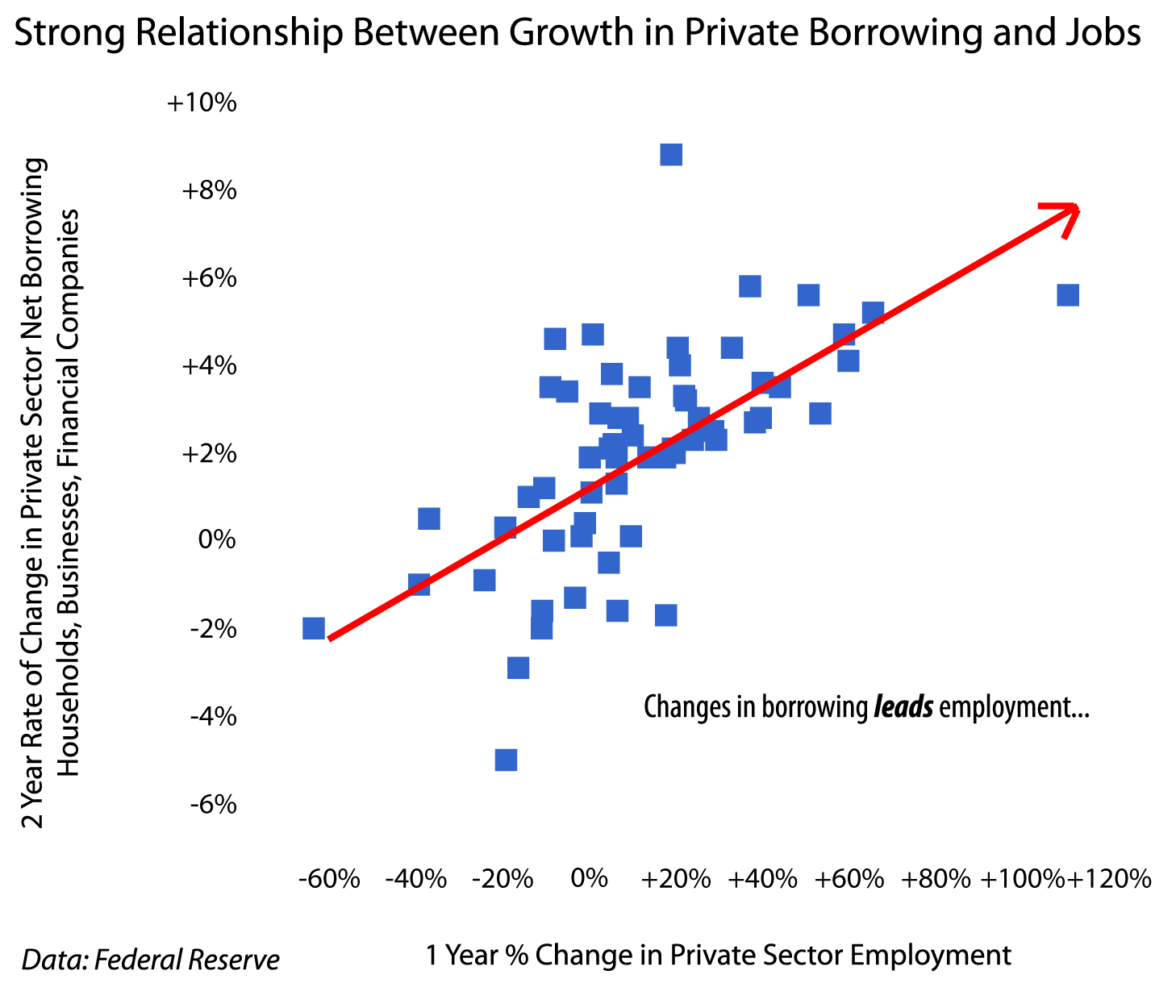
1946. When debt expansion slows, there is a strong tendency
for the economy to falter. This is apparent when comparing
changes in private sector net borrowing to changes in
private sector employment. The following graph depicts the
relationship between debt and employment growth in the
private sector. We see here that there is a strong tendency
for private sector employment (seen along the x-axis) to
rise and fall in response to a change in private sector
borrowing (seen along the y-axis). Thus, the larger the
contraction in private borrowing, the larger the expected
falloff in private employment. It is not at all surprising
that the rate of unemployment has reached 10% with the rate
of underemployment reaching near 17%, in light of the fact
that private borrowing peaked in the third quarter of 2007
at a net annualized growth rate of $4.7 trillion and has now
slid to a contracting rate of -$2.2 trillion on an
annualized basis. It is hard to envision how private sector
employment would increase alongside private sector debt
liquidation.
[Click chart to enlarge]
One other surprising fact about this data is that, despite the
improvement in financial markets during the second and third
quarter, the pace of debt liquidation appears to be
accelerating. Households were liquidating debts at an annualized
rate of -$160 billion in Q1; -$215 billion in Q2; and -$351
billion in Q3. Similarly, companies were growing debt at an
annualized rate of $53 billion in Q1; began net liquidation to
the tune of approximately -$249 billion in Q2; and liquidated at
a rate of -$283 billion in Q3. Financial companies, which hold
the largest concentration of debt among any sector at over $16
trillion, have been liquidating debt at a $1.5-$2 trillion pace
this year. This process has been aided by the Federal Reserve,
which has injected capital into the banks by buying up roughly
$1 trillion of assets from those same banks. We anticipate that
the Fed will attempt to engineer additional purchases well into
2010, which could further balloon the size of their balance
sheet. Stay tuned.
The seemingly counter-intuitive fact that accelerating private
sector debt liquidation is occurring alongside a wide variety of
observations showing improvement in the economy can only be
explained by two potential phenomena. It could be that the
public senses that the improvements are superficial and
tentative because they do not see the positive effect of
government actions in their immediate circumstances. On the
other hand, the trend toward higher savings rates and debt
liquidation could have longer-lived secular characteristics.
As we have written about in the past, potential drivers for
longer-run, secular shifts are:
1. A much higher degree of private sector debt and leverage than
in the past;
2. Boomers’ exit from peak spending years;
3. A negligible change in the cost of money from boom years;
4. Structural changes to regulatory and tax code that inhibit
risk-taking.
Ultimately, time will whether this is just another credit cycle
and will follow the normal cyclical pattern leading to a
sustained recovery, or whether these secular changes produce a
markedly different outcome. So far, markets have answered Ben
Bernanke’s prayer. Soon, we will see if the private sector is
similarly inclined.
|
Past Commentaries
September 30, 2009
Fourth Quarter Tactical Asset Allocation Observations
More
August 24, 2009
Trough Earnings and the Path Forward
More
July 20, 2009
Third Quarter Tactical Asset Allocation Observations
More
March 13, 2009
A Big Hit to Wealth and What to Do Now?
More
March 5, 2009
A Questionable Plan and a Free Market Silver Lining?
More
January 7, 2009
Can Policymakers Create Just a Little Inflation?
More
December 11, 2008
Household Credit Turns Negative...
More
November 21, 2008
Credit: Don't Want It... Can't Get It...
More
September 24, 2008
Downgrading Outlook Based on Credit Freeze
More
September 15, 2008
Equity Markets Stumble on Lehman, Merrill, and AIG
More
September 9, 2008
No Change In Strategy On GSE Action
More
July 31, 2008
Quick Take on GDP Report
More
July 21, 2008
Valuation Are Better, But Markets Are Not Out of the
Woods
More
March 10, 2008
Investing During Recession
More
January 22, 2008
Global Sell-off
More
December 27, 2007
Outlook 2008
More
December 7, 2007
NBER President Raises Recession Concerns
More
November 28, 2007
Equity Risk Heightened - Allocation Remains Defensive
More
September 25, 2007
After the Rate Cut
More
July 30, 2007
The Case For Growth
More
June 15, 2007
Data Affirms Tactical Asset Allocation Posture
More
March 19, 2007
Cutting Earnings And Equity Target
More
| |
To unsubscribe, please click here.
Company Name, Address and Contact Details
Opinions expressed are subject to change without notice and do not take into
account the particular investment objectives, financial situation, or needs of
individual investors. There is no guarantee that the figures or opinions
forecasted in this report will be realized or achieved.
The information contained herein has been prepared from sources believed to be
reliable but is not guaranteed by us and is not a complete summary or statement
of all available data, nor is it considered an offer to buy or sell any
securities referred to herein. Employees of Stifel, Nicolaus & Company, Incorporated or its
affiliates may, at times, release written or oral commentary, technical
analysis, or trading strategies that differ from the opinions expressed within.
Past performance is no guarantee of future results.
Indices are unmanaged, and you cannot invest directly in an index.
There are special
considerations associated with international investing, including the risk of
currency fluctuations and political and economic events. Investing in emerging
markets may involve greater risk and volatility than investing in more developed
countries. Due to their narrow focus, sector-based investments typically exhibit
greater volatility. Small company stocks are typically more volatile and carry
additional risks, since smaller companies generally are not as well established
as larger companies. Property values can fall due to environmental, economic, or
other reasons, and changes in interest rates can negatively impact the
performance of real estate companies. When investing in bonds, it is important
to note that as interest rates rise, bond prices will fall. High-yield bonds
have greater credit risk than higher quality bonds. The risk of loss in trading
commodities and futures can be substantial. You should therefore carefully
consider whether such trading is suitable for you in light of your financial
condition. The high degree of leverage that is often obtainable in commodity
trading can work against you as well as for you. The use of leverage can lead to
large losses as well as gains.
Stifel, Nicolaus & Company, Incorporated | Member SIPC & NYSE |
www.stifel.com |
|
 | | |